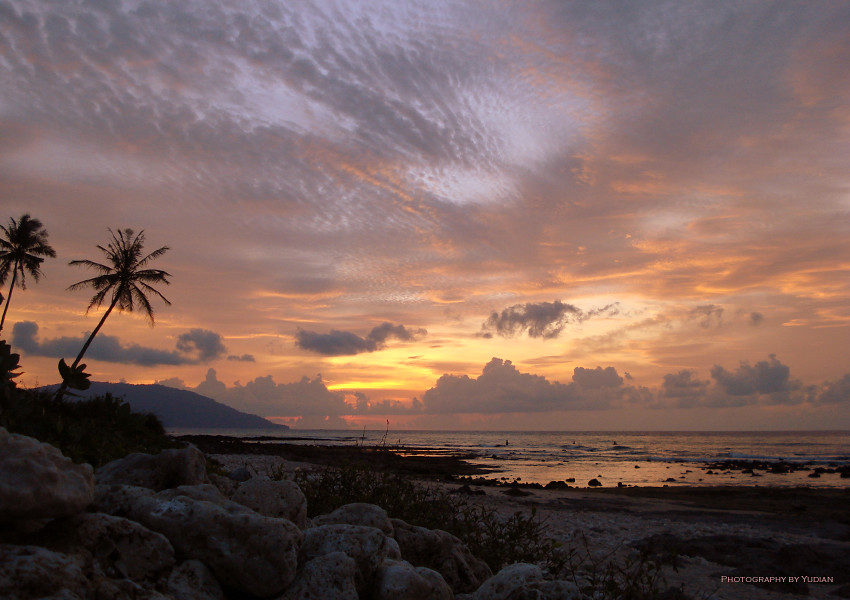
Selasa, 28 Oktober 2014


Aceh is a special region of Indonesia. The province is located at the northern end of Sumatra. Its capital is Banda Aceh. It is close to the Andaman and Nicobar Islands of India and separated from them by the Andaman Sea.

Aceh is thought to have been the place where the spread of Islam in Indonesia started, and was a key part of the spread of Islam in Southeast Asia. In the early seventeenth century the Sultanate of Aceh was the most wealthy, powerful and cultivated state in the Malacca Straits region. Aceh has a history of political independence and resistance to control by outsiders, including the former Dutch colonists and the Indonesian government.
East Aceh, Sabang Province
Aceh is a diverse region occupied by several ethnic and language groups. The major ethnic groups are the Acehnese (who are distributed throughout Aceh), Gayo (in central and eastern part), Alas (in Southeast Aceh Regency), Tamiang-Malays (in Aceh Tamiang Regency), Aneuk Jamee (descendant from Minangkabau, concentrated in southern and southwestern), Kluet (in South Aceh Regency), and Simeulue (on Simeulue Island). There is also a significant population of Chinese, who are influential in the business and financial communities. Among the present day Acehnese can be found some individuals of Arab, Turkish, and Indian descent. Before the tsunami, the region of Meureuhom Daya (Lamno) used to have an unusually high number of people with fair complexions, blue eyes and blond hair, which local traditions attributed to Turkish or Portuguese ancestry.

Here is the place I recommend to visit:

1. Baiturrahman Grand Mosque

The Baiturrahman Grand Mosque is the Aceh Sultanate Mosque, The mosque was designed by a Dutch architect Bruins and built by the Dutch colonial administration as a reconciliation following the destruction of an older mosque during the Aceh Wars. Construction of the mosque commenced in 1879 and was completed in 1881. The original mosque was smaller and consisted of a single dome. Years later the mosque was renovated and expanded by constructing additional wings. The mosque survived the massive 2004 tsunami, because of it's high standard (European) contruction, which destroyed much of the rest of the city of Banda Aceh. 

2. Sabang

Sabang is a town name on a island north of Banda Aceh on the northern tip of Sumatra. Strictly speaking, the island's name is Weh Island (Pulau Weh) and Sabang is the main town on the north coast, but the names are often used interchangeably. Among locals the place is more often referred to as "Sabang" but among tourists it is well known as "Pulau Weh". The island is best known for its snorkeling and diving.
Paradiso Beach
Sabang has many tourist destinations especially nature tourism. In Sabang Area Master Plan 2007 - 2021 has been established tourist areas that will be prioritized in the development of Sabang Tourism Region in the period of 5 years to come is in the area of ​​marine tourism and Gapang Iboih. Further developed the International Zone's Nest Cave Resort in Kampung Paya, Old Town Revitalization Sabang and development of nautical tourism in Nipah Beach (P. Rice). Gapang Iboih tourist area and a marine tourism destination serving the underwater scenery is very beautiful. This scene can be enjoyed by diving or by boat with a glass bottom that has been available there. Exploration of the beauty of the underwater world in Iboih and Gapang can proceed to P. Rubiah. In addition to the underwater scenery, tourism potential that can be managed from Iboih and Gapang is fishing (fishing game). Tourism potential is an opportunity to attract tourists the world with all international facilities.
Diving In pulau Weh

Here is the potential of the natural attractions (nature tourist attraction) in Sabang Area

- Rubiah Island Marine Park

- Iboih Beach

- Gapang Beach


- Tread Elephant Coast


History 
The Dayaks tribes came to Kalimantan as a migration from other parts in Asia about 3000 years ago.
Dayak are defined in more then 200 different tribes, the main tribes are the Bakumpai and Dayak Bukit of South Kalimantan; the Ngajus and Baritos of Central Kalimantan; the Benuaqs, Kayan, Kenyah, and the nomadic Punan of East Kalimantan, and the Ibans of West Kalimantan and Malaysian Borneo. 

Dayak People
Traditionally, Dayak agriculture was based on swidden hill rice cultivation called "ladang" and "hutan. Dayaks organize their labor in terms of holding groups which determined who owned rights to land and how it was to be used. Nowadays, the Dayaks work in the mining industry, wood industry, and on the plantations of Kalimantan. 

Religion

The Dayak indigenous religion is a form of animism called "Kaharingan", and seems to be close with Hinduism. The practice of Kaharingan religion differs from tribe to tribe. The spirit is believed to partake in the celebration, a mark of honor and respect to past ancestries and blessings for a prosperous future. 
Offering Ceremony of Dayak's People

Since 1970 missionaris came in to Kalimantan and most Dayaks converted to Christianity which was introduced by European and American missionaries. The relations between all religious groups are generally good. Despite the destruction of pagan religions in Europe by Christians, most of the people who try to conserve the Dayak's religion are missionaries.

In the Coastal cities the populations are largely Muslim, influanced by the relatively high cultural Javanese Majapahit Kingdoms and the Islamic Malay Sultanates that appeared periodically throughout Southeast Asian history. 

Society

The Dayaks live in longhouses, which is a structure of hardwood posts that can be hundreds of meters long, mostly located along a river bank. At one side there is a long communal platform, the other side (back side) has the individual households apartments for each family. 

Mandau looks from the front.
Headhunting kept the practice of old headhunts alive and was an important part of Dayak culture. The Dayak wars In the past Reports captured enemy heads, there have been massive coordinated raids in the interior, and throughout coastal Kalimantan. 

Mandau (machetes) is a a narrow strip of a harder iron wedged into a slot in the cutting edge for sharpness. Headhunting necessitated being able to draw the machete quickly. The mandau is short, and nowadays used for trail cutting in the forest. It is holstered with the cutting edge facing upwards and at that side there is an upward protrusion on the handle, so it can be drawn very quickly with the side of the hand without having to reach over and grasp the handle first. The hand can then grasp the handle while it is being drawn. The combination of these three factors (short, cutting edge up and protrusion) makes for an extremely fast drawing action. The ceremonial mandaus used for dances are as beautifully adorned with feathers as the dresses are. 

The Daily life of Dayak

If you want, you might follow some fishermans to catch fish. Their fishing technique start from using fishing rod until using unique nets. You will feel satisfy after you enjoy your catch result. 

Then, to complete your travel you can go to hunt deers and wild boar with locals. Dayak tribe fulfill their necessities of life  by hunting around the forest, they also have unique hunt methods. They don't hunt animals by gesit but somehow those animals come to approach Dayak people.
Dayak Wariors
How they can do that? They have unique methods in attract attention of animal. When they hunt the deer, they imitate the sound of young deer. Because of the deer isn't always protecting its children, the female deer directly approach to that sound.In hunting, they use spear. The spear has a function to catch an animals from the far distance by fling it to that animal, or it is also can used with poison needle, which is implanted into the end-spear then blown into the target. 

More information about Palangkaraya, Dayak tribe, and another tourism object in Indonesia especially in Central Kalimantan, please visit Wonderful Indonesia.

Senin, 27 Oktober 2014

Indonesia In World Map. (freeworldmaps.net)
Indonesia, officially the Republic of Indonesia, is a sovereign state in Southeast Asia and Oceania. Indonesia is an archipelago comprising thousands of islands. It encompasses 33 provinces and 1 Special Administrative Region (for being governed by a pre-colonial monarchy) with an estimated population of over 252 million people, making it the world's fourth most populous country. Indonesia's republic form of government comprises an elected legislature and president. The nation's capital city is Jakarta. The country shares land borders with Papua New Guinea, East Timor, and Malaysia. Other neighboring countries include Singapore, the Philippines, Australia, Palau, and the Indian territory of the Andaman and Nicobar Islands.

Indonesia's location on the edges of the Pacific, Eurasian, and Australian tectonic plates makes it the site of numerous volcanoes and frequent earthquakes. Indonesia has at least 150 active volcanoes, including Krakatoa and Tambora, both famous for their devastating eruptions in the 19th century. The eruption of the Toba supervolcano, approximately 70,000 years ago, was one of the largest eruptions ever, and a global catastrophe. Recent disasters due to seismic activity include the 2004 tsunami that killed an estimated 167,736 in northern Sumatra,and the Yogyakarta earthquake in 2006. However, volcanic ash is a major contributor to the high agricultural fertility that has historically sustained the high population densities of Java and Bali.

Bromo Mount in East Java
Indonesia's size, tropical climate, and archipelagic geography, support the world's second highest level of biodiversity (after Brazil), and its flora and fauna is a mixture of Asian and Australasian species. The islands of the Sunda Shelf (Sumatra, Java, Borneo, and Bali) were once linked to the Asian mainland, and have a wealth of Asian fauna. Large species such as the tiger, rhinoceros, orangutan, elephant, and leopard, were once abundant as far east as Bali, but numbers and distribution have dwindled drastically. Forests cover approximately 60% of the country. In Sumatra and Kalimantan, these are predominantly of Asian species. However, the forests of the smaller, and more densely populated Java, have largely been removed for human habitation and agriculture. Sulawesi, Nusa Tenggara, and Maluku – having been long separated from the continental land masses—have developed their own unique flora and fauna. Papua was part of the Australian landmass, and is home to a unique fauna and flora closely related to that of Australia, including over 600 bird species.

Orangutans are animals that live in Borneo, Indonesia
Indonesia has about 300 ethnic groups, each with cultural identities developed over centuries, and influenced by Indian, Arabic, Chinese, and European sources. Traditional Javanese and Balinese dances, for example, contain aspects of Hindu culture and mythology, as do wayang kulit (shadow puppet) performances. Textiles such as batik, ikat, ulos and songket are created across Indonesia in styles that vary by region. The most dominant influences on Indonesian architecture have traditionally been Indian; however, Chinese, Arab, and European architectural influences have been significant.

Indonesian cuisine varies by region and is based on Chinese, European, Middle Eastern, and Indian precedents. Rice is the main staple food and is served with side dishes of meat and vegetables. Spices (notably chili), coconut milk, fish and chicken are fundamental ingredients. Indonesian traditional music includes gamelan and keroncong. The Indonesian film industry's popularity peaked in the 1980s and dominated cinemas in Indonesia, although it declined significantly in the early 1990s. Between 2000 and 2005, the number of Indonesian films released each year has steadily increased.


Ramayana Ballets in Prambanan Temple, Yogyakarta.
Both nature and culture are major components of Indonesian tourism. The natural heritage can boast a unique combination of a tropical climate, a vast archipelago of 17,508 islands, 6,000 of them being inhabited, the third longest shoreline in the world (54,716 km) after Canada and the European Union. It is the worlds largest and most populous country situated only on islands. The beaches in Bali, diving sites in Bunaken, Mount Bromo in East Java, Lake Toba and various national parks in Sumatra are just a few examples of popular scenic destinations. These natural attractions are complemented by a rich cultural heritage that reflects Indonesia's dynamic history and ethnic diversity. One fact that exemplifies this richness is that 719 living languages are used across the archipelago. The ancient Prambanan and Borobudur temples, Toraja, Yogyakarta, Minangkabau, and of course Bali, with its many Hindu festivities, are some of the popular destinations for cultural tourism.
 
© 2012. Design by Main-Blogger - Blogger Template and Blogging Stuff